
1
We map where the tissue stops gliding.
You did the surgery, the cast and the waiting, and the arm still will not glide. Slow, sustained pressure on the layer that is stuck, then movement so it stays that way.
What It Is
Fascia is the thin sheet everything in your forearm slides through. Muscle, tendon, nerve. After an injury or a surgery it can thicken and stick down. The muscle underneath is perfectly fine. The movement still is not.
This is the slowest of our hands-on techniques, and that is the point. Manual therapy works the joint. Active Release Technique asks you to move while we hold. IASTM brings in a bevelled tool. Cupping lifts the tissue up. Myofascial release parks on one layer at low force and waits, because fascia gives to sustained load, not to speed.
So no, it is not a massage, and it is not an hour of relaxation. We go where your cause-first evaluation says the restriction is, and we stop when that layer starts gliding. Then you move it, same visit, so the tissue learns the new range. Scar does not soften on its own. Every month it sits is a month it gets more organised.
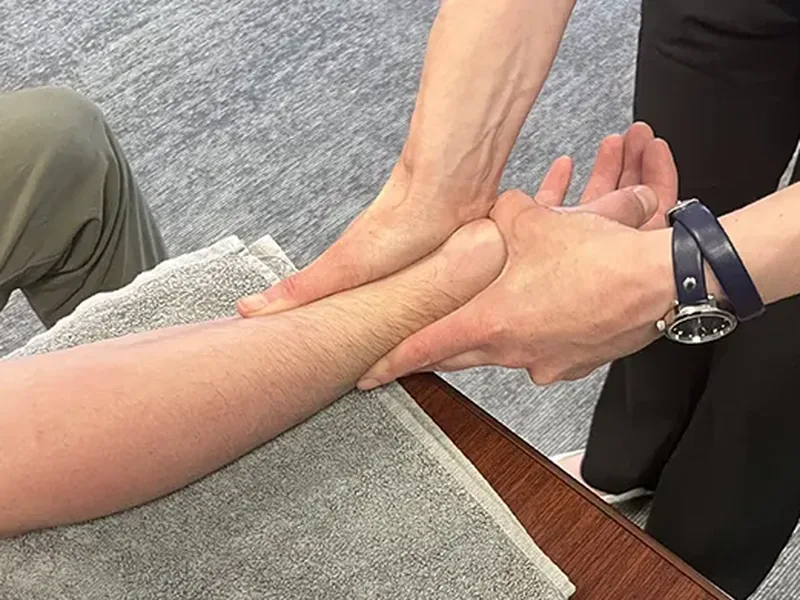 Slow on purpose. Fascia ignores speed.
What It Helps
If any of these is the reason you are reading this page, you are in the right spot.
What A Session Looks Like
1
We map where the tissue stops gliding.
2
Steady, low pressure. Held until it gives.
3
You move it, before it sets again.
Why It Works
An arm that glides instead of catching.
Scar that answers after months of not.
A recovery that stopped stalling.
Motion that outlasts the appointment.
Pairs Well With
Questions, Answered
It is slow and it is low force, which surprises people bracing for deep tissue work. You feel steady pressure, then a give. If a scar is still raw we work around it and stay in the Pain phase until it settles. You set the pressure out loud, and we hold exactly there.
No, and the difference is time. A massage moves across a lot of tissue at speed. Myofascial release stays on one restricted layer and waits it out, because fascia changes under sustained load rather than under strokes. We also pick the spot from your evaluation, not from where you feel sore, and we follow it with movement in the same visit.
We use it while the fascia is the thing holding you back, and we drop it the moment it stops earning its place. It sits inside a plan with an endpoint and four phases, Pain, Prime, Perform and Prevent. Most of our patients arrive by physician referral, and we will help you find out what your own plan requires. For coverage, start with the payers listed on our insurance page, or call us at (360) 989-1200.
Book Your Visit
Request a time and a real person from our front desk calls you back to get you scheduled. No phone tree. No ‘someone will reach out.’ Just a plan.
5.0 · 146 Google reviews
Your request goes straight to our front desk
Step 1 of 5
That’s the hard part done. We’ll call during clinic hours to get you on the schedule and tell you what to bring.
Visit Us