
Starts visit one
Pain
Get the elbow off the hook.
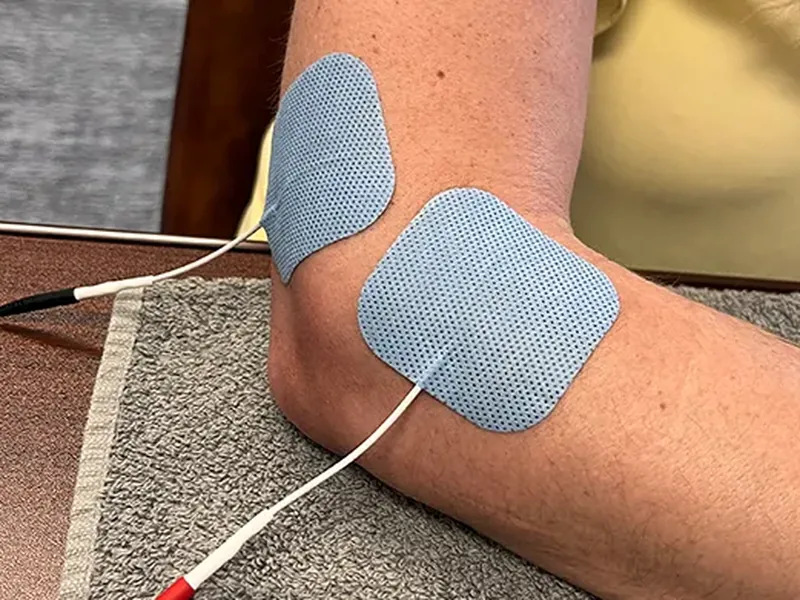
Hands-on soft tissue work and offloading, so the anchor stops taking the full pull every time you pick something up.
What We Treat
Most people who get it have never held a racket. It is a hot spot on the outside of the elbow that lights up on a coffee cup, a key, a handshake. The tendon did not fail. It got out-worked.
Sound Familiar?
Two or more? Keep reading.
Why It Happens
The muscles that cock your wrist back all anchor to one small bump on the outside of your elbow. Every time you grip, that anchor takes the pull. Grip often enough, hard enough, without enough recovery in between, and the tendon stops rebuilding as fast as you are wearing it. In plain terms, the fibers get disorganized rather than inflamed. That is why the name says inflammation and the tissue says something else.
It also explains the pattern you already know. Rest feels great, because you removed the pull. The first real week back and it is furious again, because nothing about the pull changed. The grip, the tool, the wrist angle and the shoulder feeding into it are all still exactly where they were. You did not stop working. You just started working around it. That is not the same as healing.
The Honest Truth
Nobody regrets starting too early. The rest-and-hope loop is the part people wish they had skipped.
How We Fix It
Every plan has an endpoint. Here is what the four phases look like for tennis elbow.
Starts visit one
Pain
Hands-on soft tissue work and offloading, so the anchor stops taking the full pull every time you pick something up.
Once the pain settles
Prime
Wrist, forearm and elbow motion, plus the shoulder above it, so one small tendon stops absorbing everybody else’s job.
Once the motion holds
Perform
Graded, progressive loading is what actually reorganizes tendon tissue. This is the phase that makes the fix hold.
Before discharge
Prevent
Tool size, wrist angle, technique and pacing get changed, so the same load stops landing on the same square inch. That is the endpoint.
Love Gabbert Clinic! I had aches in my arm and hand for nearly four months before I finally went here — I saw huge improvement within two weeks and was completely pain-free within a month. Everyone is super friendly and nice, the techs are all very knowledgeable and great at finding which exercises are going to improve your condition, no matter what stage of healing you’re in. Would absolutely recommend them to anyone who needs to strengthen muscles, calm inflamed nerves, feel stronger, and sleep better.
Shared by Stephanie C. · Arm and hand pain
Where you start: wincing on a handshake and hiding it
Where the plan ends: a grip you load without negotiating with it
Questions, Answered
Because rest calms a tendon down, it does not build one back up. Tennis elbow is a tendon that stopped keeping up with the load you put through it. Take the load away and it quiets. Put the load back and it flares. The answer is graded loading, added in the right order, which is exactly what the Perform phase is for.
The Pain phase comes first for a reason. We calm the elbow and take the pull off the tendon before we ask it to do anything. Only then does load go on, in steps you can feel yourself handle. You are one-on-one with your therapist for the whole visit, so nothing gets pushed past what your elbow is ready for.
Tendons answer that question, not websites, so we tell you after the evaluation rather than before it. What you get either way is a plan with an endpoint. You will know which of the four phases you are in, Pain, Prime, Perform or Prevent, and what is left before you are done.
Book Your Visit
Request a time and a real person from our front desk calls you back to get you scheduled. No phone tree. No ‘someone will reach out.’ Just a plan.
5.0 · 146 Google reviews
Your request goes straight to our front desk
Step 1 of 5
That’s the hard part done. We’ll call during clinic hours to get you on the schedule and tell you what to bring.
Visit Us