
1
We find the joint that stopped moving.
Your hands are how you work, drive and open the door. Hands-on joint and soft tissue work gets that wrist moving, done by your therapist, never an aide.
What It Is
Manual therapy is skilled hands on your joints and the tissue wrapped around them. Glides at the joint surface. Sustained holds at the end of your range. Guided motion you could not produce on your own yet. No machine, no tool. Your therapist’s hands and your arm.
It is the broadest of our hands-on techniques, and usually the first one we reach for. Myofascial release goes slower and stays on one layer. Active Release Technique asks you to move while we hold. IASTM swaps fingertips for a bevelled tool. Cupping lifts instead of pressing. Manual therapy is the joint itself.
It is not a massage. A massage is built around how it feels while it happens. This is built around one restriction found in your cause-first evaluation, and it is followed by exercise in the same visit so the motion has a reason to stay. That sequence matters more than it sounds. Stiffness sets while you wait, and motion gets harder to win back the longer it sits.
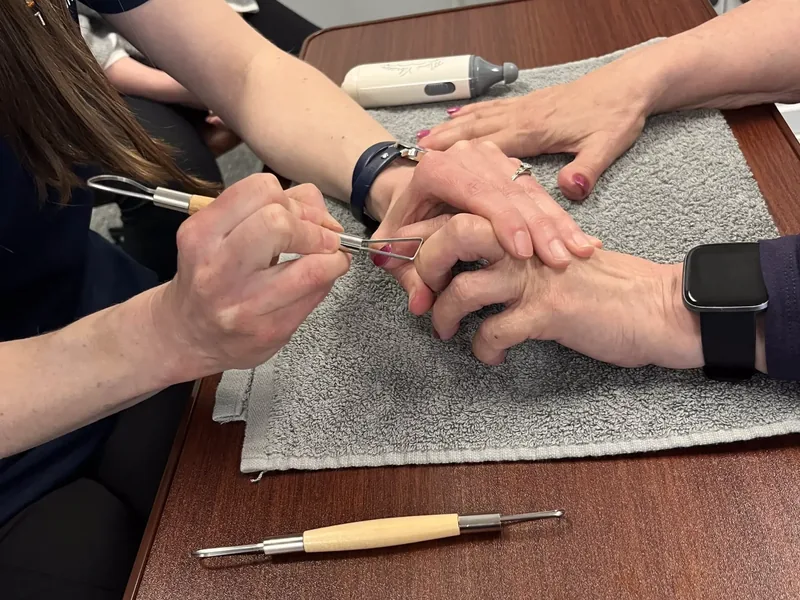 Your therapist’s hands, not an aide’s
What It Helps
If any of these is the reason you are reading this page, you are in the right spot.
What A Session Looks Like
1
We find the joint that stopped moving.
2
Hands-on work, at a pressure you set out loud.
3
Exercise the same visit, so the motion holds.
Why It Works
A wrist that turns a key again.
Motion you can feel change in the room.
The restriction treated, not the sore spot.
Gains that hold, because exercise follows.
Pairs Well With
Questions, Answered
It should feel like firm, purposeful pressure, not a fight. Some of it lands near a joint that is already sore, so we start in the Pain phase and work at a level you set out loud. Say ease off and we ease off. Nothing here happens without you knowing what it is for.
No. A massage is built around how it feels while it is happening. Manual therapy is built around one restriction your therapist found in a cause-first evaluation, on a joint that will not move. It also does not end on the table. You do the movement work in the same visit, because that is what makes the change last.
Manual therapy is one tool inside a plan with an endpoint, not a standing appointment. You move through the four phases, Pain, Prime, Perform and Prevent, and we stop when the motion is back. Most of our patients arrive by physician referral, and we will help you sort out what your own plan requires. For coverage, start with the payers listed on our insurance page, or call us at (360) 989-1200.
Book Your Visit
Request a time and a real person from our front desk calls you back to get you scheduled. No phone tree. No ‘someone will reach out.’ Just a plan.
5.0 · 146 Google reviews
Your request goes straight to our front desk
Step 1 of 5
That’s the hard part done. We’ll call during clinic hours to get you on the schedule and tell you what to bring.
Visit Us