
Starts visit one
Pain
Calm it down.
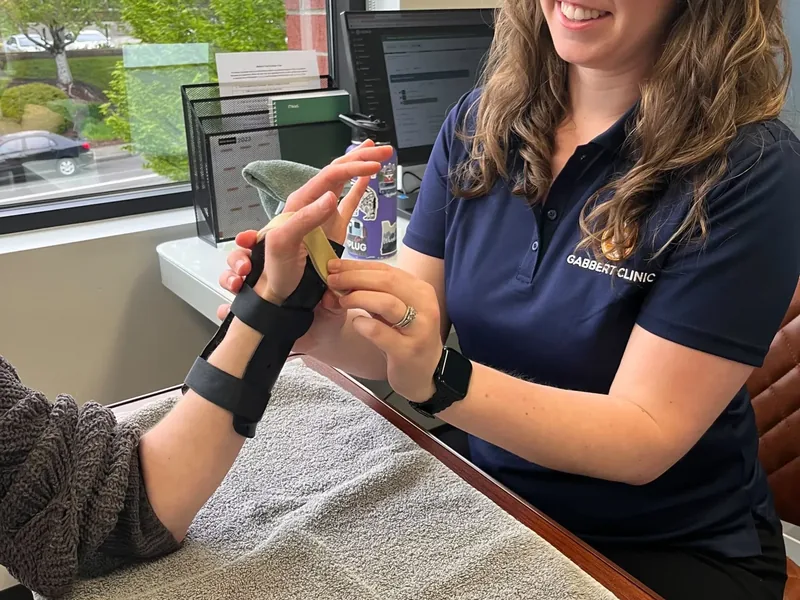
Hands-on work on swelling and fresh scar, plus a splint fabricated here, so the hand rests in a position that helps instead of one that costs you.
What We Treat
The surgery is done. Now the hand has to learn to be a hand again: the button, the jar lid, the key in the door. That part is its own job, and you do it one-on-one with a licensed Occupational Therapist, several board-certified in hand therapy (CHT), every visit.
Sound Familiar?
Two or more? Keep reading.
Why It Happens
Healing tissue lays down scar, and scar is not tidy. It grips whatever it touches, which in a hand means tendons that should glide. Swelling that sits long enough stops being swelling and becomes stiffness. Joints held still in a cast get tight. Muscles go quiet after weeks of not being asked. Your surgeon fixed the structure. Scar, swelling and stiffness are a second problem, and that one decides how much of your hand comes back.
You have not been slacking. You have been resting it, protecting it, and waiting for the next follow-up, because that is what you were told to do. But a photocopied exercise sheet doesn’t know where your scar is, and a general clinic treats a hand like a small shoulder. Hand therapy is its own board certification: a graduate degree, 4,000 hours of hand practice, and a board exam. Our Certified Hand Therapists hold it. Your plan starts with a cause-first evaluation that works inside your surgeon’s protocol, not around it.
The Honest Truth
Your hands are how you do your job, hold your kid, and sign your name. Nobody regrets starting too early.
How We Fix It
Every plan has an endpoint. Here is what the four phases look like once the repair is done.
Starts visit one
Pain
Hands-on work on swelling and fresh scar, plus a splint fabricated here, so the hand rests in a position that helps instead of one that costs you.
Once the pain settles
Prime
Scar mobilization and graded motion, taken exactly as far as your surgeon’s protocol and your healing tissue allow. Not one degree of guessing.
Once the motion holds
Perform
Strength and dexterity, loaded on purpose: pinch, grip, and the fine motion your job and your morning actually ask of that hand.
Before discharge
Prevent
We test the hand against your real tasks, at work and at home, and you leave with something you keep doing. That is the endpoint, not just another appointment.
I have been a patient at Gabbart Hand Clinic for over seven months, from my initial injury through surgery and now post-surgical rehabilitation. Throughout every stage, the level of care has been exceptional. The entire team is highly skilled, attentive, and compassionate. They take time to explain procedures, answer questions, and make sure you understand your recovery plan. The therapists are patient and encouraging, creating an environment that supports both physical healing and peace of mind. Thanks to their expertise and dedication, my recovery has been steady and successful. I highly recommend Gabbart Hand Clinic to anyone in need of hand or upper extremity care. They truly are the best in Vancouver.
Shared by Jevona M. · Post-surgical rehabilitation
Visit one: a hand fresh out of a splint that does not want to open
Prevent phase: back to your own tools, buttons and steering wheel
Questions, Answered
As soon as your surgeon clears you, and that is often earlier than people expect. Bring your operative report and any protocol the surgeon sent, because your plan gets built inside it. If the protocol says wait, we wait, and we tell you exactly what we are waiting for. If you are not sure whether you have been cleared yet, call us and we will help you find out.
Moving a repaired hand is the job, not the risk, and it happens inside the protocol your surgeon set. The first phase is called Pain for a reason: we settle swelling and fresh scar down before we ask the tissue for anything. You are one-on-one with a licensed Occupational Therapist every visit, so someone is watching how the hand responds and adjusting that day. Nothing gets pushed past what the repair can take.
You get a plan with an endpoint, not an open tab of appointments. Your evaluation lays out what has to happen in each of the four phases, Pain, Prime, Perform, and Prevent, and what has to be true before your hand earns the next one. The protocol your surgeon set and the way your tissue responds set the pace, so we tell you what we are seeing rather than guess at a number on day one.
Book Your Visit
Request a time and a real person from our front desk calls you back to get you scheduled. No phone tree. No ‘someone will reach out.’ Just a plan.
5.0 · 146 Google reviews
Your request goes straight to our front desk
Step 1 of 5
That’s the hard part done. We’ll call during clinic hours to get you on the schedule and tell you what to bring.
Visit Us