
Starts visit one
Pain
Turn the alarm down.
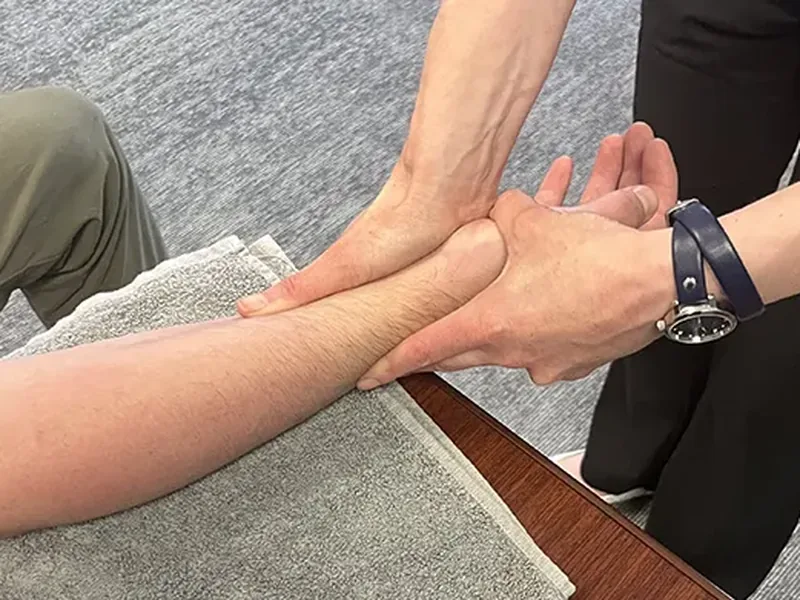
Hands-on work, desensitization and swelling control, all pitched at a level your hand can tolerate, starting your very first visit.
What We Treat
The jar you hand to someone else. The sleeve you have to work your arm into. The one sleeping position that is bearable. Pain that outlasted the injury is its own problem, and it is treated one-on-one with a licensed Occupational Therapist, several board-certified in hand therapy (CHT), every visit.
Sound Familiar?
Two or more? Keep reading.
Why It Happens
When pain outlives the injury, the problem has usually moved. The nerves carrying the signal get better at carrying it, so a small input sets off a big alarm. Meanwhile the hand gets used less, because using it hurts. Joints stiffen. Skin gets touchy. Swelling settles in. Strength quietly drains away. Now there are two problems feeding each other, and in Complex Regional Pain Syndrome that loop is the diagnosis itself.
Your hands are how you do your job, hold your kid, and sign your name. You do not get to put them on a shelf and wait. Medication turns the volume down without changing what is producing the signal. Resting the hand feels right and makes the second problem worse. A generic exercise sheet asks for more than a sensitized hand can give, so you stop after two days and decide you failed. You did not. Two people can carry the same diagnosis and need two completely different plans, which is why this starts with a cause-first evaluation.
The Honest Truth
Nobody regrets starting too early. The longer a hand sits still, the more it costs to wake it back up.
How We Fix It
Every plan has an endpoint. Here is what the four phases look like when pain has outlasted the injury.
Starts visit one
Pain
Hands-on work, desensitization and swelling control, all pitched at a level your hand can tolerate, starting your very first visit.
Once the pain settles
Prime
Graded motion and scar work, plus a custom splint fabricated and remolded here when a joint needs help holding its position.
Once the motion holds
Perform
Grip, pinch and dexterity loaded back on purpose, so the hand relearns that being used is safe rather than threatening.
Before discharge
Prevent
We work through the list you quietly gave up, and you leave knowing how to handle a flare without losing ground. That is the endpoint, not just another appointment.
The Gabbert Clinic is an outstanding team of talented and caring people who work together to find solutions to challenging issues. I came to them with Complex Regional Pain Syndrome and many affected joints. They address the CRPS and helped me move forward to regain the use of my hand. I have observed that every patient is important to them and they work together as a team to find the best solutions for each person. Thank you Gabbert Client
Shared by Regie B. · Complex Regional Pain Syndrome
Visit one: a hand you have stopped asking to do anything
Prevent phase: back to the tasks you quietly handed to someone else
Questions, Answered
Because it starts with a cause-first evaluation instead of a protocol. Two people can carry the same diagnosis and need two completely different plans, so we look at what is driving your pain before we treat it. You work one-on-one with a licensed Occupational Therapist every visit, our team includes board-certified hand therapists, and the plan changes when your hand does.
That fear is reasonable, and it is exactly why the first phase is called Pain. We start at a level your hand tolerates, which for a sensitized hand can be very gentle, and build from there. Your therapist reads how you respond during the session and adjusts that same day. Nothing gets pushed just to hit a number on a chart.
You get a plan with an endpoint, not an open tab of appointments. Your evaluation maps the four phases, Pain, Prime, Perform, and Prevent, and what has to be true before you move from one to the next. Pain that has been around a while moves at its own pace, so we tell you what we are seeing instead of guessing at a number on day one.
Book Your Visit
Request a time and a real person from our front desk calls you back to get you scheduled. No phone tree. No ‘someone will reach out.’ Just a plan.
5.0 · 146 Google reviews
Your request goes straight to our front desk
Step 1 of 5
That’s the hard part done. We’ll call during clinic hours to get you on the schedule and tell you what to bring.
Visit Us