
1
Sensors on the skin. Nothing under it.
After a nerve injury or a stroke, the hand stops answering and you cannot feel why. Biofeedback puts that missing signal on a screen, so you can find the contraction and train it back.
What It Is
The hard part is not that you stopped trying. You are trying. The muscle just is not reporting back, so you cannot tell a real contraction from a wish. That is what makes a hand after a nerve injury or a stroke so maddening to work on alone.
Biofeedback puts small sensors on the skin over that muscle and turns its electrical activity into a line on a screen. Now the contraction has a picture. You can chase it, hold it, and watch it get bigger week over week. That is motor relearning, and it moves faster when the feedback is immediate and honest.
Your hands are how you do your job, hold your kid and sign your name, and a muscle that goes unasked gets harder to recruit the longer it waits. So we run this one-on-one with a licensed Occupational Therapist, several board-certified in hand therapy (CHT), every visit. To be clear about what it is not: this is not neurofeedback and it is not a relaxation session. We are not training brainwaves. We are teaching one muscle to answer.
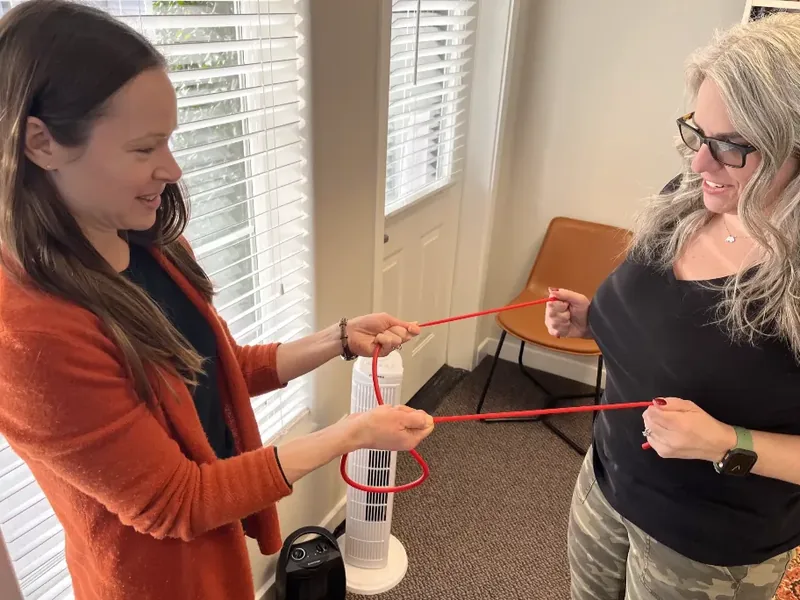 Objective, not a guess
What It Helps
If any of these is the reason you are reading this page, you are in the right spot.
What A Session Looks Like
1
Sensors on the skin. Nothing under it.
2
You chase the line on the screen.
3
The signal becomes a real task.
Why It Works
Proof the muscle is still there.
Effort that finally goes somewhere.
Progress you can watch, not guess at.
A faster road back to the task itself.
Pairs Well With
Questions, Answered
No. The sensors sit on the surface of your skin. Nothing goes into the muscle and nothing is forced or shocked. What you feel is your own effort, and that is the whole point. If the arm is sore or freshly post-op, we work inside the Pain phase first and keep the effort at a level your tissue can take. You can stop at any moment.
Only while the signal is hard to find. Biofeedback is a tool inside a plan, not a standing appointment, and your therapist drops it as soon as you can find the contraction without the screen. What you get at your evaluation is a plan with an endpoint, built on the four phases, Pain, Prime, Perform, Prevent. You will always know which phase you are in and what earns the next one.
Most of our patients arrive by physician referral, and some plans require one before we can bill, so tell us who you are with and we will help you sort out what yours needs. The plans we work with are listed on our insurance page. We check your exact benefits before your first visit and tell you what we find, in plain language, before anything is billed. Questions now? Call us at (360) 989-1200.
Book Your Visit
Request a time and a real person from our front desk calls you back to get you scheduled. No phone tree. No ‘someone will reach out.’ Just a plan.
5.0 · 146 Google reviews
Your request goes straight to our front desk
Step 1 of 5
That’s the hard part done. We’ll call during clinic hours to get you on the schedule and tell you what to bring.
Visit Us