
1
We see how the arm moves today, and where the tone stops it.
A hand that opens far enough to wash, to dress, to hold something again. We get there with positioning, splinting, sustained stretch and Saebo certified protocols, one-on-one with a licensed Occupational Therapist, every visit.
What It Is
Spasticity is not weakness. After a stroke, a brain injury or a spinal cord injury, the signal that tells a muscle to let go stops arriving. The muscle stays switched on. That is the fist that will not open, the elbow that will not straighten, the arm that pulls in tighter when you are tired or startled or cold.
Which is why the usual advice backfires. Squeeze harder, work the grip, push through it: all of that feeds tone. We do the opposite. Positioning, splinting, sustained stretch and Saebo certified protocols give the muscle a reason to release, and only then do we ask it to work.
This is not an injection and it does not replace one. If your physician is timing Botox or managing baclofen, we build around that schedule, because the window after an injection is when stretch and splinting buy the most ground. And we name honest goals out loud. Sometimes the goal is a fork. Sometimes it is a palm you can clean, a sleeve that goes on without a fight, and an arm that stops aching at night. Those count too.
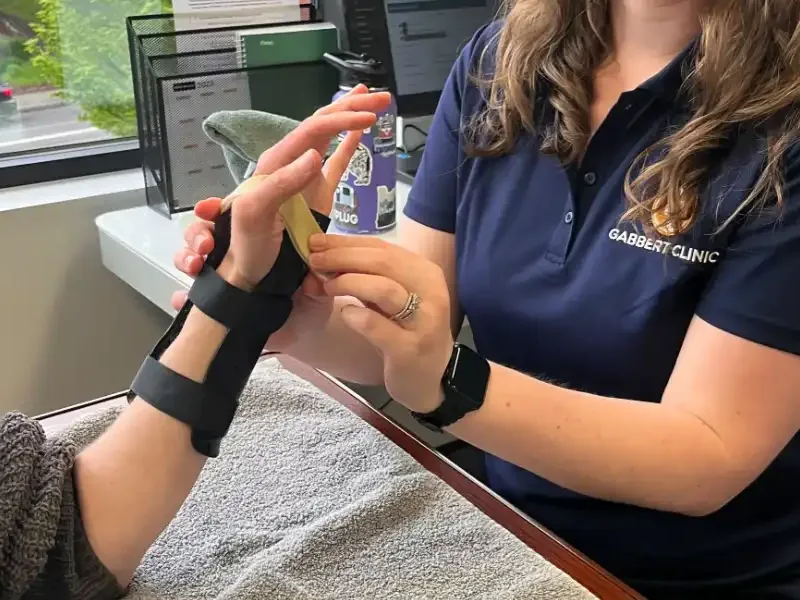 Hygiene and comfort count as goals
What It Helps
If any of these is the reason you are reading this page, you are in the right spot.
What A Session Looks Like
1
We see how the arm moves today, and where the tone stops it.
2
Slow stretch, warmth, positioning. Nothing forced, nothing yanked.
3
You leave with the splint schedule and the home plan, written down.
Why It Works
A palm that opens enough to clean.
Dressing that stops being a wrestling match.
Less of the deep ache that tone brings at night.
Motion protected while it is still winnable.
Pairs Well With
Questions, Answered
It depends on what the tone is doing and how long it has been doing it, so nobody honest hands you a number on a web page. What you get here is a plan with an endpoint. We work the four phases, Pain, Prime, Perform and Prevent, and you will always know which phase you are in, what its job is, and what has to happen to earn the next one. If your physician is timing injections, the plan is built around that schedule.
Most of our patients arrive with one. After a stroke or a brain injury it usually comes from a neurologist, a physiatrist or a primary care physician, and many insurance plans require one before they will pay. Call us at (360) 989-1200 with the plan details and we will tell you what yours actually asks for, then help you get it sorted before the first visit.
Very likely. The full payer list lives on our Insurance page and it is long: Regence BCBS, Medicare, Washington L&I, Providence, TriWest and PacificSource are all on it. We verify your exact benefits before your first visit and tell you what we find, so the bill is not a surprise. Call (360) 989-1200 if you want us to start that today.
Book Your Visit
Request a time and a real person from our front desk calls you back to get you scheduled. No phone tree. No ‘someone will reach out.’ Just a plan.
5.0 · 146 Google reviews
Your request goes straight to our front desk
Step 1 of 5
That’s the hard part done. We’ll call during clinic hours to get you on the schedule and tell you what to bring.
Visit Us