
Starts visit one
Pain
Settle the arm down first.
Hands-on work on tightness, tone, swelling and shoulder or wrist pain, so the rest of the plan has somewhere to stand.
What We Treat
The button that takes three tries. A hand that works Monday and quits on you Thursday. We do not treat the disease. We work on what your hands and arms still have to do, one-on-one with a licensed Occupational Therapist, every visit.
Sound Familiar?
Two or more? There is work we can do.
Why It Happens
Multiple sclerosis interrupts the message travelling between your brain and your hands. What reaches the muscle can arrive late, weaker, or scrambled. That shows up as clumsiness, a grip that fades partway through a task, fingertips that feel far away, and an arm that tires long before the job is done. Heat and fatigue turn the volume up on all of it. None of that is you being careless.
Occupational therapy does not treat the disease itself. That is your neurologist’s work, and we will not pretend otherwise. What we do is take apart the tasks your day is actually made of, then find where strength, coordination, sensation, positioning or plain energy is the limiting factor. Sometimes the answer is training. Sometimes it is a different way to hold the tool. Usually it is both, worked one task at a time with a licensed Occupational Therapist.
The Honest Truth
No clock is running here. There is only how much of your own day you hand over while you wait.
How We Fix It
Your hands are how you dress, eat, work and sign your name. Those are not things you put on a shelf and wait on. Here is what the four phases look like when the diagnosis is MS.
Starts visit one
Pain
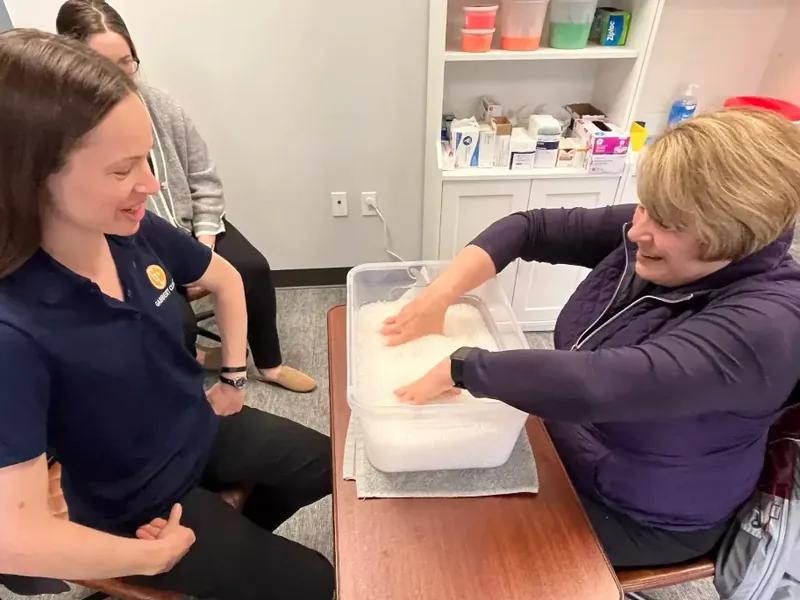
Hands-on work on tightness, tone, swelling and shoulder or wrist pain, so the rest of the plan has somewhere to stand.
Once we have a baseline
Prime
Range, sensation and coordination work, dosed to your fatigue instead of fighting it, so the hand has something to work with.
Once the basics hold
Perform
Buttons, cutlery, keyboard, steering wheel. We train the tasks you named, and adapt the ones that need adapting.
Reviewed as you go
Prevent
Energy conservation, joint protection, and a home routine you can still run in a bad week: that is the endpoint, not just another appointment.
The clinicians at this clinic are very professional and knowledgeable. I know when I arrive here I will be treated well and will be given tools and resources to aid my quick recovery. I highly recommend Gabbert Clinic
Shared by Karena M. · Google review
Visit 1: we write down the tasks that have gotten harder
Every visit after: we work that list, in your order of importance
Questions, Answered
No. Nothing we do changes the disease itself, and you deserve to hear that plainly. Your neurologist manages the MS. Occupational therapy works on what the MS is costing you day to day: grip, dexterity, hand fatigue, sensation, and the tasks that have gotten harder. The goal is keeping your hands on your own job, your own kitchen and your own morning routine, for as long as possible.
Then we work the bad day. Fatigue and heat sensitivity are part of the picture, not an interruption to it. Your therapist adjusts the session to the day you actually walked in with, and some of the most useful work happens exactly then: pacing, positioning, and what to do when a hand quits early. You will never be pushed into a flare to finish a program.
You get a plan with an endpoint, not an open tab of appointments. Your plan runs through all four phases, Pain, Prime, Perform, and Prevent, and you will always know which phase you are in and what is left. MS is long term, so many people finish a block of visits, go live their life, and come back when something changes. That is a normal way to use us.
Book Your Visit
Request a time and a real person from our front desk calls you back to get you scheduled. No phone tree. No ‘someone will reach out.’ Just a plan.
5.0 · 146 Google reviews
Your request goes straight to our front desk
Step 1 of 5
That’s the hard part done. We’ll call during clinic hours to get you on the schedule and tell you what to bring.
Visit Us