
1
We find the spot that catches on movement.
Your forearm is how you earn a living, and it gives out by Thursday. We hold one spot while you move, so the tissue gets treated where it actually fails.
What It Is
Active Release Technique is a specific hand contact plus your own active movement. Your therapist finds the spot, holds tension right there, and you take the arm through its range. The tissue gets worked while it slides, which is the state it actually fails in.
That is the whole difference between this and its neighbours. Manual therapy works the joint. Myofascial release holds still and waits. IASTM brings in a bevelled tool. Cupping lifts the tissue up. ART is the only one of the five where you are working too, which is why any one spot takes a short, specific effort rather than a long one.
So it is not a massage, and you will not be lying there passively. It is one of the better answers for repetitive strain from work or sport, and for a nerve that has gotten stuck in scar and complains every time you reach. Rest alone does not fix that. It feels better by Sunday and it is back on Monday. If your problem turns out not to be this, we will say so and use something else.
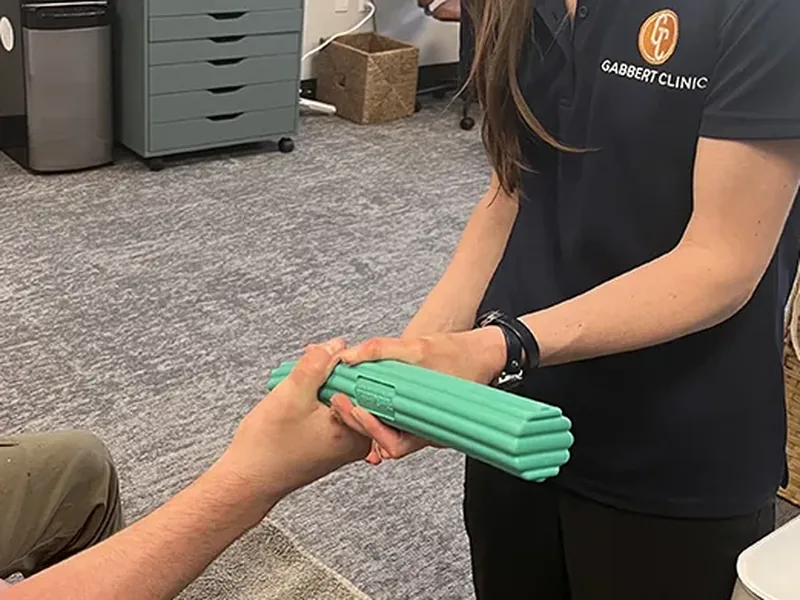 You are moving, not lying still
What It Helps
If any of these is the reason you are reading this page, you are in the right spot.
What A Session Looks Like
1
We find the spot that catches on movement.
2
We hold. You take it through range. Brief.
3
Straight into loading, the same visit.
Why It Works
A forearm that lasts the whole shift.
Reaching that stops setting off the nerve.
Strain treated where it actually fails.
Less time on the table, more on the work.
Pairs Well With
Questions, Answered
There is usually a moment where you feel the exact spot, and then it eases as you move through it. It is brief, because the movement is brief. We start in the Pain phase, you tell us what pressure is workable, and we hold at that. Nothing here needs you to grit your teeth, and you can stop it at any point.
No. A massage works tissue at rest, and a stretch pulls the whole length of it. Active Release Technique pins one spot and asks you to move the arm underneath that contact, so the tissue is treated through its full glide. That is why it suits repetitive strain, where the tissue is fine until it has to slide.
It is one tool inside a plan with an endpoint, not something you come back for forever. We use it while the tissue is the limiter, then we spend the visit on loading, because the four phases, Pain, Prime, Perform and Prevent, are what make the change stick. Most of our patients arrive by physician referral, and we will help you find out what your own plan requires. For coverage, start with the payers listed on our insurance page, or call us at (360) 989-1200.
Book Your Visit
Request a time and a real person from our front desk calls you back to get you scheduled. No phone tree. No ‘someone will reach out.’ Just a plan.
5.0 · 146 Google reviews
Your request goes straight to our front desk
Step 1 of 5
That’s the hard part done. We’ll call during clinic hours to get you on the schedule and tell you what to bring.
Visit Us