
Starts visit one
Pain
Take the load off.
Hands-on work, and a splint made here when it helps, so the irritated tissue finally gets quiet. You get told exactly what she can keep doing meanwhile.
What We Treat
She shakes her wrist out between turns. She ices it in the car. She stopped mentioning it, which is not the same as it getting better. Her evaluation and every session after it run one-on-one with a licensed Occupational Therapist, several board-certified in hand therapy (CHT).
Sound Familiar?
Two or more? Keep reading.
Why It Happens
A wrist was built to hang, not to carry a whole body. Every handstand, round-off and vault turns it into a weight-bearing joint, at the end of its range, hundreds of times a week. In a still-growing athlete the growth plate at the end of the forearm bone is the softest link in that chain, and repeated compression is exactly what irritates it. Stack a full season on top with no quiet weeks, and the tissue never gets a chance to catch up.
You are not the parent who overreacts. You are the parent who noticed. You have already tried the sensible things: taping it, a week off, ibuprofen before practice. Those turn the pain down. They do not change the load that is producing it, which is why it comes back at the same point every season. A cause-first evaluation sorts out what is actually taking that load and what has to change. Hand and wrist therapy is its own board certification: a graduate degree, 4,000 hours of hand practice, and a board exam. Our Certified Hand Therapists hold it.
The Honest Truth
Nobody regrets starting too early. A wrist she can still compete on is worth one phone call.
How We Fix It
Every plan has an endpoint. Here is what the four phases look like for a wrist that gets landed on.
Starts visit one
Pain
Hands-on work, and a splint made here when it helps, so the irritated tissue finally gets quiet. You get told exactly what she can keep doing meanwhile.
Once the pain settles
Prime
Motion and forearm mechanics, so the wrist opens the way a handstand needs instead of jamming at the very end of its range.
Once the motion holds
Perform
Weight bearing rebuilt in steps, from a wall handstand to full support, using the skills her events actually ask of her.
Before discharge
Prevent
Wrist prep, grip work and load habits she keeps using in the gym, plus what to watch for. That is the endpoint, not just another appointment.
This office and their staff are absolutely FANTASTIC! If I ever have an issue with my hand/wrist/forearm I know exactly where to go!
Shared by Hunter R. · Hand, wrist and forearm
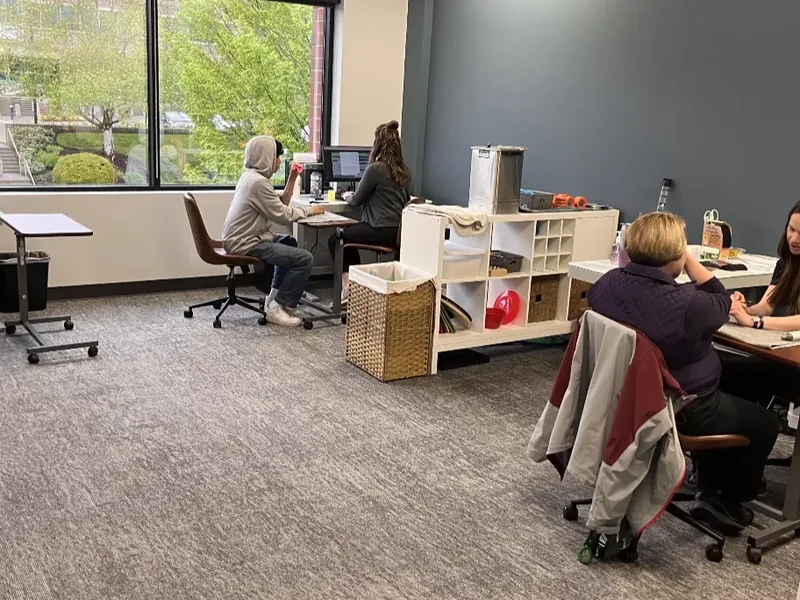
Visit one: shaking the wrist out between turns and calling it fine
Prevent phase: full weight bearing, and a plan for the heavy weeks
Questions, Answered
Not automatically, and that is the first thing we sort out. Some wrists need a real break from weight bearing. Others need a change in volume, in setup, or in how the wrist gets loaded, while she keeps training around it. Her therapist evaluates the wrist and then tells you which one she is, in plain language, along with what she can keep doing this week. You get an answer, not a blanket sit-out order.
Most of our patients arrive with a referral from a physician or a surgeon, and many insurance plans require one before they cover therapy. Some plans do not. Send us her plan details and we check the benefits before her first visit, then tell you exactly what yours needs. Sorting that part out is not your job to do alone.
You get a plan with an endpoint, not an open tab of appointments. Her evaluation maps the four phases, Pain, Prime, Perform, and Prevent, and what has to be true before she earns the next one. Her season, her skills and the way the wrist responds set the pace, so we tell you what we are seeing instead of guessing at a number on day one.
Book Your Visit
Request a time and a real person from our front desk calls you back to get you scheduled. No phone tree. No ‘someone will reach out.’ Just a plan.
5.0 · 146 Google reviews
Your request goes straight to our front desk
Step 1 of 5
That’s the hard part done. We’ll call during clinic hours to get you on the schedule and tell you what to bring.
Visit Us