
Starts visit one
Pain
Settle the arm down.
Hands-on work on the irritated tissue, plus a throwing volume we agree on together, so the shoulder finally gets a real chance to quiet down.
What We Treat
He is icing after every outing. His velocity is down and nobody can say why. He tells you it is fine, in the same voice every time. His evaluation and every session after it run one-on-one with a licensed Occupational Therapist, every visit.
Sound Familiar?
Two or more? Keep reading.
Why It Happens
Throwing asks the shoulder to stop an arm moving faster than almost anything else in sport. The rotator cuff and the muscles that steer the shoulder blade do that braking. When the blade is late, or the cuff is tired, the joint quietly trades away motion: tight at the back, loose at the front. In a growing athlete, the growth plate at the top of the arm bone absorbs that repeated stress too. Then overlapping seasons never give any of it a real off-week.
You are not the parent who pulls a kid at the first ouch. You are the parent who does not want to be the one who let him throw through something. The week off, the band routine off the internet, the longer warm-up: those turn the soreness down. They do not change the mechanics that produced it, which is why it comes back at the same point in the season. A cause-first evaluation finds what is actually failing, and you work one-on-one with a licensed Occupational Therapist, every visit.
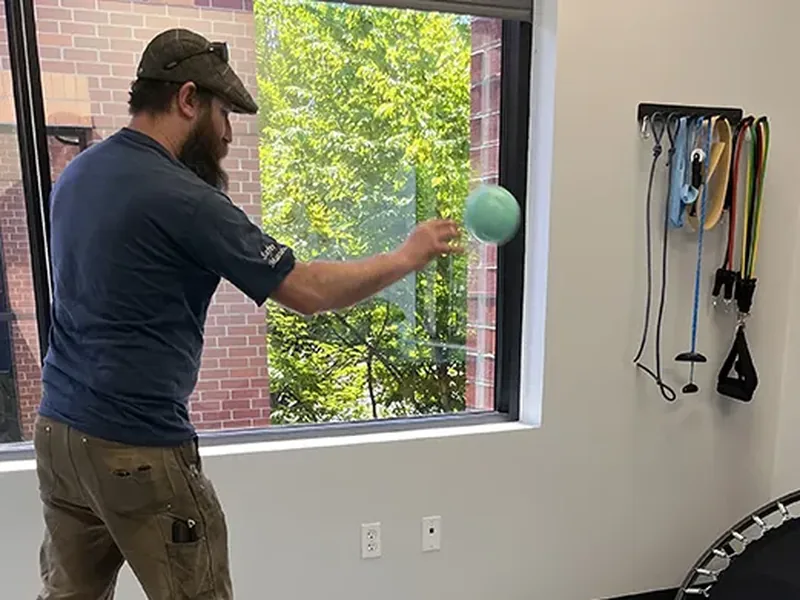
The Honest Truth
Nobody regrets starting too early. A throwing shoulder is easier to protect than to rebuild.
How We Fix It
Every plan has an endpoint. Here is what the four phases look like for a young arm that hurts.
Starts visit one
Pain
Hands-on work on the irritated tissue, plus a throwing volume we agree on together, so the shoulder finally gets a real chance to quiet down.
Once the pain settles
Prime
Motion at the back of the shoulder and control of the shoulder blade, because that is usually where a throwing arm has quietly lost range.
Once the motion holds
Perform
Cuff and shoulder blade strength loaded the way pitching loads it, so the arm can decelerate instead of only accelerate.
Before discharge
Prevent
Prep and recovery work he actually keeps doing, plus the warning signs so you catch it earlier next time. That is the endpoint, not just another appointment.
Meghan is exceptional to work with and her young protege Brooklyn doesn’t just mimic but adds to the therapy sessions in a positive manner
Shared by Erik H. · Google review
Visit one: icing the shoulder after every outing and hiding it
Prevent phase: a prep routine he keeps doing without being asked
Questions, Answered
Not automatically, and that is the first thing we sort out. Some arms need a real break. Others need a change in volume and in mechanics while he keeps throwing. His therapist evaluates the shoulder first, then tells you which one he is and what he can keep doing this week. You get an actual answer instead of a blanket order to rest it.
If he is icing after every outing, losing velocity, or staying sore longer than he used to, that is worth an evaluation even when he says he is fine. Kids under-report arm pain because they want the ball. A cause-first evaluation tells you what you are actually dealing with, which beats guessing from the bleachers.
You get a plan with an endpoint, not an open tab of appointments. His evaluation maps the four phases, Pain, Prime, Perform, and Prevent, and what has to be true before he earns the next one. Where he is in the season and the way the shoulder responds set the pace, so we tell you what we are seeing instead of guessing at a number on day one.
Book Your Visit
Request a time and a real person from our front desk calls you back to get you scheduled. No phone tree. No ‘someone will reach out.’ Just a plan.
5.0 · 146 Google reviews
Your request goes straight to our front desk
Step 1 of 5
That’s the hard part done. We’ll call during clinic hours to get you on the schedule and tell you what to bring.
Visit Us