
Starts visit one
Pain
Get the limb comfortable.
Swelling, scar, skin tolerance and nerve sensitivity get treated first, so the socket can fit and wearing it does not cost you the whole evening.
What We Treat
A prosthesis arrives in a box. Nobody is born knowing how to use one. You learn it one-on-one with a licensed Occupational Therapist, several board-certified in hand therapy (CHT), every visit.
Sound Familiar?
Two or more? Keep reading.
Why It Happens
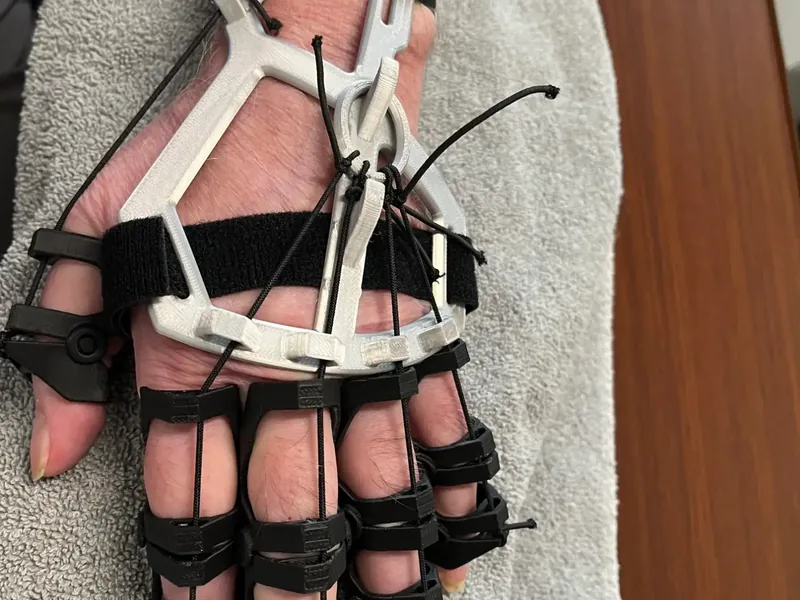
A prosthesis does not give you a hand back. It gives you a tool, and a tool has to be learned one movement at a time until it stops taking all of your attention. That is skill work. Skill work needs repetition, feedback, and somebody watching what your shoulder starts doing to compensate.
Meanwhile the limb itself needs care. Skin toughens or breaks down, scar tightens, swelling changes how the socket fits, and nerves keep sending signals from a hand that is gone. The sound arm quietly does double duty, which is how it ends up hurting too. A cause-first evaluation looks at all of it: the limb, the device, the other arm, and the tasks you actually need back.
The Honest Truth
Nobody regrets starting too early. A device you can use is worth far more than a device you own.
How We Treat It
Every plan has an endpoint. Here is what the four phases look like when you are learning an upper limb prosthesis.
Starts visit one
Pain
Swelling, scar, skin tolerance and nerve sensitivity get treated first, so the socket can fit and wearing it does not cost you the whole evening.
Once we have a baseline
Prime
Controls, grips, getting it on and off, and a wear schedule that builds. Repetition with a therapist watching, not a pamphlet from the fitting appointment.
Once the basics hold
Perform
Two-handed tasks: the jar, the shoelace, the keyboard, the job. Graded up until the device stops taking every bit of your attention.
Reviewed as you go
Prevent
Load gets shared instead of dumped on the sound side, skin checks become routine, and you leave knowing exactly when to call us. That is the endpoint.
The Gabbert Clinic provides a truly exceptional level of patient care, delivered by a staff that is both highly professional and genuinely compassionate. From the moment I checked in, the administrative team was efficient and welcoming, making the entire process stress-free.
Shared by Mario M. · Google review
What people arrive with: a device handed over at the fitting, and nobody to practice with
What happens here: controls, grips and two-handed tasks, drilled until they stop being a project
Questions, Answered
Yes, and starting before the device arrives is often the better order. The work ahead of a fitting is real work: swelling down, scar softened, skin tolerant to pressure, range kept, and the sound arm trained so it does not silently take over everything. Then the device has something to fit and somebody ready to learn it. Tell us where you are in the fitting process and we build around it.
Most of our patients come to us by physician referral, and after limb loss that is the usual route. What your own plan requires depends on your insurance, and we will help you sort out what is needed before your first visit. Call the clinic and we walk you through it. You should not have to fight paperwork on top of everything else.
You get a plan with an endpoint, not an open tab of appointments. Your therapist maps the four phases, Pain, Prime, Perform and Prevent, and names what each phase has to accomplish before the next one starts. Learning a device is skill work, so the honest measure is tasks, not weeks. You will always know which phase you are in and what is left.
Book Your Visit
Request a time and a real person from our front desk calls you back to get you scheduled. No phone tree. No ‘someone will reach out.’ Just a plan.
5.0 · 146 Google reviews
Your request goes straight to our front desk
Step 1 of 5
That’s the hard part done. We’ll call during clinic hours to get you on the schedule and tell you what to bring.
Visit Us