
Starts visit one
Pain
Take the tightness down.
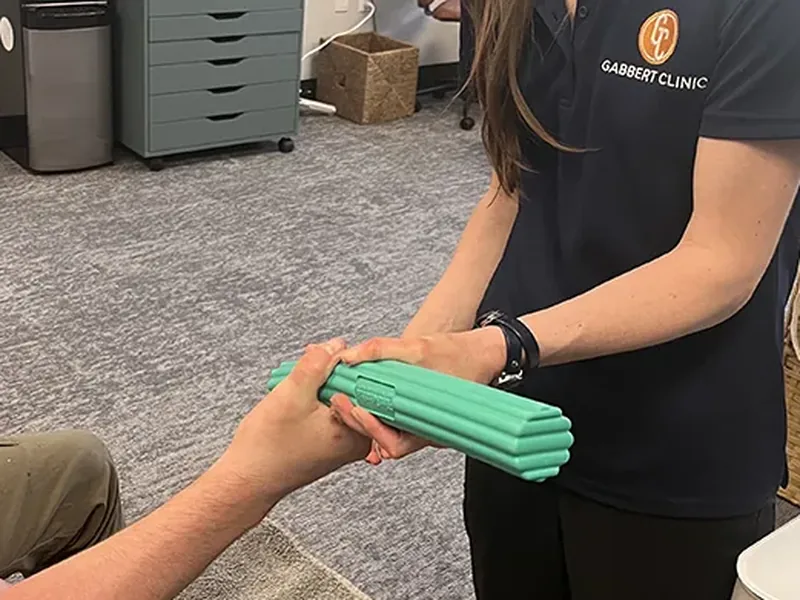
Hands-on work on tone, tight muscles and any sore joints, plus a splint fabricated here if the hand needs help staying open.
What We Treat
The pencil grip. The jacket zipper. Getting a fork up without the whole arm coming along. The goal is not a different kid. The goal is a morning and a school day that work, built one-on-one with a licensed Occupational Therapist, every visit.
Sound Familiar?
Two or more? Those are the things we build a plan around.
Why It Happens
Cerebral palsy comes from an early injury to a developing brain. The message still gets sent, but what arrives at the muscle is too much or not enough. Muscles fire when they should be quiet, tone pulls a hand toward a fist, and the fine control a pencil or a button needs never gets a clean run at it. Then a second thing happens: a hand that is hard to use gets used less, and tight muscles get tighter.
Occupational therapy does not change the cerebral palsy. What it builds is participation: the hand skills, the strength, the positioning and the setups that let a kid do their own morning, their own worksheet, their own play. We work on what your child actually needs this year, and we work with you, because you are the one who is there for the other 167 hours of the week.
The Honest Truth
Nothing about cerebral palsy is on a clock. The school year is, and so is how much of it your child gets to do themselves.
How We Fix It
You are the parent who reads the report twice and gets everyone to the appointment. Amy started her career in pediatric hand therapy at Scottish Rite Hospital for Children in Dallas. Here is what the four phases look like for a child with cerebral palsy.
Starts visit one
Pain
Hands-on work on tone, tight muscles and any sore joints, plus a splint fabricated here if the hand needs help staying open.
Once we have a baseline
Prime
Range, positioning and sensory work, so the hand has something to work with before we ask it to do a job.
Once the basics hold
Perform
Pencil, scissors, buttons, cutlery and two-handed play, practiced as the actual task, and mostly as a game.
Reviewed as you go
Prevent
You leave with the home program, the setups and the classroom strategies that keep the skills: that is the endpoint, not just another appointment.
Amy works with my son who has spastic Cerebral Palsy. Amy is extremely collaborative and knowledgeable and he LOVES going to see her. I would highly recommend her to any parents looking to support their kid’s school success with functional skills.
Shared by Lauren K. · Parent, spastic cerebral palsy
Visit 1: we pick the skills that matter this school year, with you
Every visit after: we work them one at a time, and you stay in the loop
Questions, Answered
Not the cerebral palsy itself, and you should hear that from us rather than work it out later. What changes is participation. How much of the morning your child can do alone. Whether a pencil grip lasts a whole worksheet. Whether both hands work together for play and self-care. We set the goals with you, in plain language, and you will know whether we are hitting them.
Mostly playing, watching, and asking you questions. It is a cause-first evaluation, so your therapist looks at tone, range, grip and how your child actually goes about a task, then works out what is limiting it. Nothing gets forced. You stay in the room. We would rather spend a session earning your kid’s trust than get one clean measurement out of a bad morning.
You get a plan with an endpoint, not a standing appointment. The plan runs through all four phases, Pain, Prime, Perform, and Prevent, and you will always know which phase your child is in and what is left. Kids grow and goals change with them, so a lot of families do a block of visits, go use the skills for a while, and come back when the next thing comes up.
Book Your Visit
Request a time and a real person from our front desk calls you back to get you scheduled. No phone tree. No ‘someone will reach out.’ Just a plan.
5.0 · 146 Google reviews
Your request goes straight to our front desk
Step 1 of 5
That’s the hard part done. We’ll call during clinic hours to get you on the schedule and tell you what to bring.
Visit Us